 Nº 01
Nº 01
Arlequín
Verde metalizado a lunares negros, adornos de encaje negro, gorro cónico a juego
Valencian sculptor and ceramicist (Bétera, 1932–1997) · Founder of Porcelanas Inglés
A digital archive dedicated to preserving and documenting the work of Ramón Inglés Capella: his training, his time at Sèvres, the founding of Porcelanas Inglés in Bétera, and the porcelain doll collection he created together with his sister Josefina "Fina" Inglés.
Nº 01 — Arlequín
Ramón Inglés Capella was born in Bétera (Valencia) on 5 May 1932, into a modest family. In 1949 he won a scholarship to study at the Manises School of Ceramics, and between 1953 and 1957 he studied at the Escuela Superior de Bellas Artes in Valencia, where he met Rosa "Lola" Sala, later the wife of Juan Lladró. He won the gold medal in 1955 and the medal of honour in 1956 at the University Art Exhibition.
A scholarship took him to the École des Beaux-Arts in Paris in 1963, and in 1964 to the Manufacture de Sèvres, where —through the efforts of ambassador José María de Areilza— he was offered a permanent sculptor position, an unusual offer for a foreigner. On his return to Spain in 1965, however, he could only find technical posts: first at Porcelanas Bidasoa (Irún), then briefly at Lladró itself, where Juan Lladró was critical of his classical style.
In mid-1966 he became chief sculptor of the artistic section at Nalda (Almàssera), until it closed in 1971. When he left to found his own brand in Bétera in 1970, Víctor de Nalda gave him several of the factory's old moulds — some rare pieces signed by Inglés come from these inherited moulds.
In 1970, Ramón founded Porcelanas Inglés in Bétera, with its own shop under the name "Inglés, Arte en Porcelana". His porcelain figures —marked by exaggerated cheeks and raised eyelashes, a style deliberately set apart from the dominant "Lladró style"— began production in 1971.
But it was his sister Josefina "Fina" Inglés Capella who contributed the idea that would become the house's most internationally recognised work: the porcelain dolls. Fina, a painter trained at the Valencia School of Fine Arts, had lived in Paris on a Casa de Velázquez scholarship, where she came into contact with the Franco-German tradition of porcelain dolls (Jumeau, Bru, Armand Marseille...). Back in Bétera, that sensibility merged with her brother's sculpture to give rise to the doll line — today the most-cited part of the factory's entire legacy.
Nº 01
Verde metalizado a lunares negros, adornos de encaje negro, gorro cónico a juego
 Nº 09
Nº 09
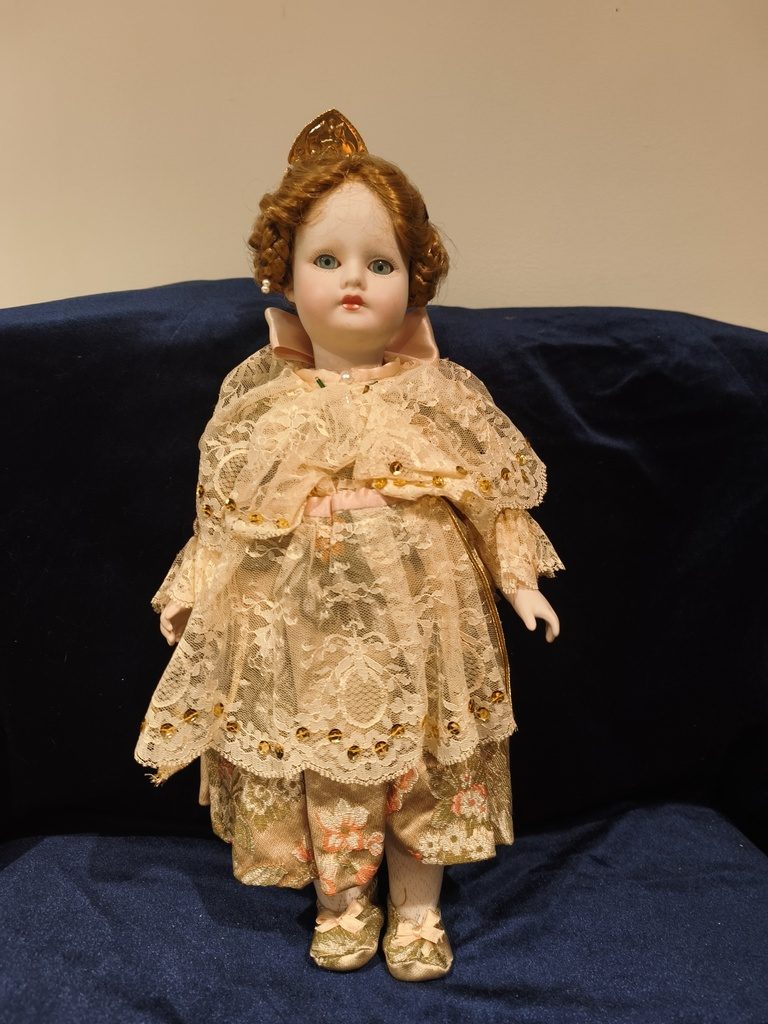
Vestido típico de fallera valenciana, con traje y adornos tradicionales, hecho por encarg…
 Nº 25
Nº 25
Sombrero y chaqueta de terciopelo rojo-terracota con encaje y flor decorativa, falda de t…
In the early 1980s, the growth of the doll business forced production to move to an old 17th-century mill —once belonging to the Carthusian friars of Valldecrist— on the boundary between Segorbe and Altura (Castellón). There the faces became more elaborate, with independent eyes and even a tilting mechanism.
Ramón's health problems, complicated financial management, and the general crisis of the Valencian porcelain sector in the 1990s —which only Lladró survived— led to the closure. Ramón Inglés died in Bétera on 3 May 1997; four months later, the town council named a street after him.
This project documents a legacy with very little reliable public information available. If you are an art historian, work at a museum or cultural institution, or collect work by Ramón or Fina Inglés, your knowledge can help complete this archive — and the archive can serve you as a citable reference source.
You can get in touch if: